


Have you ever wondered why some online stores seem to turn visitors into customers like magic, while others struggle to make a single sale? The secret might be hiding in something called a “conversion funnel.” If you’re running a Shopify store and want to see your sales numbers climb higher than ever before, you’re in the right place!
Imagine having a map that shows exactly where your customers get lost on their journey to buying from you. That’s what a conversion funnel helps you create. By the time you finish reading this article, you’ll know:
- What conversion funnels are and why they matter for your Shopify store
- How to build a funnel that guides visitors smoothly toward making a purchase
- The best ways to measure and improve each stage of your customer’s journey
- Practical steps you can take today to increase your sales
Ready to transform your Shopify store into a sales-generating machine? Let’s dive in!
Introduction to Shopify Conversion Funnels
A conversion funnel for Shopify is like a pathway that guides visitors through their shopping journey – from the moment they discover your store until they become loyal customers who keep coming back. Think of it as a step-by-step map of how people interact with your store.
Why should you care about understanding this journey? The numbers speak for themselves. Stores with well-optimized funnels see conversion rates of 3-5% compared to the industry average of just 2%. That means potentially doubling your sales without needing more traffic!
Here’s what implementing a structured conversion funnel can do for your business:
- Help you understand where customers get stuck or leave your store
- Show you exactly which parts of your store need improvement
- Allow you to make data-driven decisions instead of guessing
- Increase your revenue without necessarily increasing your marketing budget
Throughout this article, we’ll explore the five key stages that make up an effective Shopify conversion funnel: Awareness, Interest, Desire, Action, and Loyalty. Each stage represents a different part of your customer’s journey and requires specific strategies to optimize.
Now that you understand why conversion funnels are so important, let’s look at how they’re structured and how they work specifically for Shopify stores. Are you ready to see what makes a successful funnel tick? Let’s explore the anatomy of a Shopify conversion funnel!
The Anatomy of a Shopify Conversion Funnel
Core Funnel Models
Before diving into the specifics of Shopify, let’s understand the basic models that shape all conversion funnels. These frameworks help us visualize how customers move through their buying journey:
The AIDA framework breaks down customer psychology into four stages:
- Awareness: When potential customers first learn about your store or products
- Interest: When they begin exploring what you offer
- Desire: When they start wanting your products
- Action: When they make a purchase
The four-stage marketing funnel expands on this by adding post-purchase considerations:
- Awareness: Building brand recognition
- Consideration: Evaluating your products against alternatives
- Conversion: Making the purchase decision
- Loyalty: Coming back for more and recommending to others
For Shopify stores specifically, the five-stage e-commerce funnel works best:
- Awareness: Discovering your store through ads, social media, or search
- Interest: Browsing products and categories
- Desire: Reading detailed product information and reviews
- Action: Adding to cart and completing checkout
- Re-engagement: Following up with customers for reviews and repeat purchases
Shopify-Specific Funnel Visualization
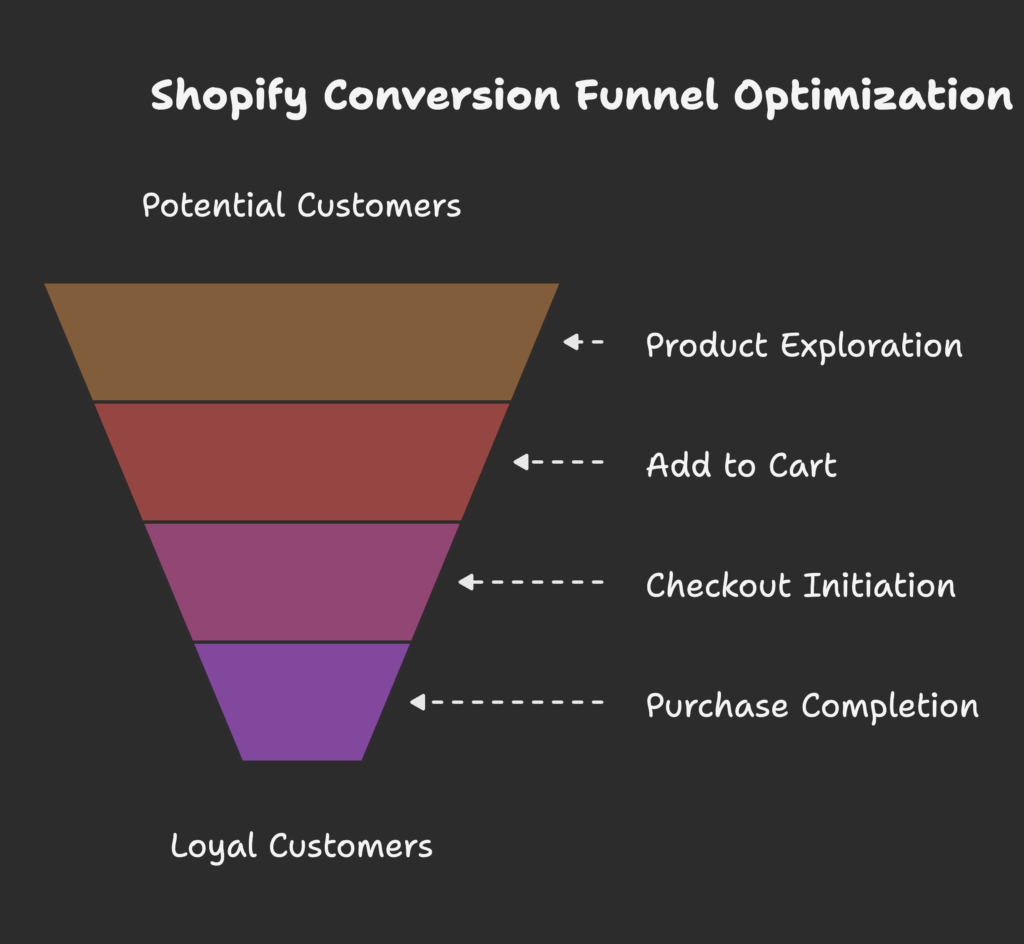
What makes Shopify special is how it helps you visualize and understand your funnel through its built-in analytics. When you log into your Shopify admin area and visit the Analytics section, you’ll see how your customers move through these key steps:
- Product page views: People looking at what you sell
- Add-to-carts: Shoppers showing interest by adding items
- Checkouts initiated: Customers starting the payment process
- Purchases completed: Successful sales
Industry benchmarks suggest that a healthy Shopify store should convert about 2% of visitors into customers overall. But breaking it down by stage helps you spot problems:
- About 8-10% of product page viewers should add items to cart
- Around 40-50% of people who add to cart should begin checkout
- Roughly 70-80% of checkouts should become completed orders
To access this valuable data in Shopify, go to Analytics → Reports → Behavior → Online store conversion over time. This report shows you exactly where customers drop off in your funnel, helping you identify the weak spots that need attention.
Now that you understand the structure of a conversion funnel, wouldn’t you like to know how to start filling the top of that funnel with potential customers? Let’s move on to the first crucial stage: Awareness!
Stage 1: Awareness – Attracting Visitors to Your Shopify Store
Traffic Generation Strategies
Getting people to discover your store is the critical first step in your conversion funnel. Without visitors, even the best-designed store won’t generate sales. Here are proven strategies to attract potential customers:
SEO optimization for Shopify stores helps you get found in search engines:
- Research and use relevant keywords in your product titles and descriptions
- Create a logical site structure with collections that make sense
- Optimize your page speed (Shopify’s Online Store 2.0 themes help with this)
- Write helpful blog content that answers questions your potential customers might have
Social media marketing builds a community around your brand:
- Choose platforms where your target customers spend time (Instagram for visual products, Pinterest for home goods, etc.)
- Share engaging content that showcases your products in use
- Engage with followers by responding to comments and messages
- Use user-generated content to build trust and showcase real customers
Paid advertising can jumpstart your traffic:
- Google Ads for capturing people actively searching for your products
- Facebook and Instagram ads for targeting specific demographics and interests
- Retargeting campaigns to bring back visitors who didn’t purchase
Content marketing attracts visitors by providing value:
- Create helpful buying guides related to your products
- Develop how-to articles that solve problems for your target audience
- Share industry news and trends that position you as an expert
Measuring Awareness Stage Performance
How do you know if your awareness strategies are working? These key metrics will tell you:
Store sessions by traffic source shows which channels bring the most visitors. In Shopify Analytics, check the “Acquisition” report to see if your social media efforts are outperforming your Google Ads, or vice versa.
Impressions and reach metrics from ad platforms and social media indicate how many people see your content, even if they don’t click through.
Bounce rate tells you if visitors quickly leave your site. A high bounce rate (over 70%) suggests your traffic sources might be bringing the wrong visitors, or your landing pages aren’t meeting expectations.
For deeper insights, connect Google Analytics to your Shopify store to track attribution models that show which channels influence purchases, even if they aren’t the last click before buying.
You’re now attracting visitors to your store—congratulations! But getting traffic is just the beginning. How do you keep these new visitors engaged and interested enough to stick around? Let’s explore the next crucial stage of the funnel!
Stage 2: Interest/Consideration – Engaging Potential Customers
Product Discovery Optimization
Once visitors arrive at your store, your goal is to help them easily find products they’ll love. The better their browsing experience, the more likely they’ll move to the next stage of your funnel. Here’s how to optimize product discovery:
Collection page optimization creates a smooth browsing experience:
- Organize products into logical, easy-to-navigate collections
- Use clear, descriptive collection titles
- Add collection descriptions that explain what shoppers will find
- Show your best-selling or highest-margin products first
Search functionality improvements help customers find exactly what they want:
- Enable predictive search to suggest products as customers type
- Add synonyms to your search settings (like “pants” and “trousers”)
- Include product filters for size, color, price, and other relevant attributes
- Consider apps like “Smart Search & Instant Search” for enhanced capabilities
Navigation and browsing experience should be intuitive:
- Keep your menu simple and organized by main categories
- Ensure your site works perfectly on mobile devices
- Use breadcrumb navigation to help visitors know where they are
- Make sure page load times stay under 2-3 seconds
Product recommendations guide shoppers to items they might like:
- Show “Customers also bought” sections on product pages
- Include “Recently viewed” items to help customers return to products they’ve seen
- Highlight complementary products that go well together
Content Strategies for Consideration
Beyond navigation, content plays a crucial role in helping customers evaluate your products:
Educational content builds trust and shows expertise:
- Create size guides for clothing or fit guides for furniture
- Develop material explanations for products where quality matters
- Share care and maintenance instructions
Comparison tools and buying guides help customers decide:
- Create “Good, Better, Best” product comparisons
- Develop “Which [product] is right for you?” guides
- Show feature comparison tables for similar products
Social proof builds confidence in your brand:
- Display customer reviews prominently
- Show the number of products sold or “X people have this in their cart”
- Include user-generated photos of products in use
Email marketing nurtures interest over time:
- Send welcome emails to new subscribers with popular product categories
- Create automated emails about frequently asked questions
- Share customer stories and testimonials
Measuring Consideration Stage Performance
To know if your consideration stage is working well, track these metrics:
Engagement rate: How many pages do visitors view? More pages usually means more interest.
Time on site: Longer visits often indicate deeper engagement with your content.
Product page view-to-cart addition ratio: This shows if your product pages are convincing. Aim for 8-10% of product page views resulting in cart additions.
Category page performance: Which collections lead to the most product views? This helps you understand what interests your visitors.
Tools like Hotjar or Lucky Orange provide heat maps and session recordings to see exactly how visitors interact with your pages, revealing opportunities for improvement.
Great job! You’ve successfully engaged your visitors and sparked their interest. But interest alone doesn’t lead to sales—you need to create desire for your products. Ready to learn how to make your customers really want what you’re selling? Let’s move to the next stage!
Stage 3: Desire – Building Preference and Intent
Product Page Optimization
Your product pages are where casual browsers transform into eager buyers. This is where you need to shine by showcasing your products in the most appealing way possible:
Compelling product descriptions that sell benefits, not just features:
- Focus on how the product solves problems or improves life
- Use sensory language that helps customers imagine using the product
- Keep paragraphs short and scannable with bullet points for key details
- Answer common questions before they’re asked
High-quality images and videos that showcase your products perfectly:
- Use multiple angles and zoom functionality
- Show the product in use or being worn
- Include size reference images or context shots
- Add short videos demonstrating the product in action
Customer review integration that builds trust:
- Display star ratings prominently near the top of the page
- Allow filtering of reviews by rating or topic
- Encourage photo and video reviews from customers
- Respond to negative reviews thoughtfully to show good customer service
Pricing presentation optimization that reduces hesitation:
- Make the value clear with “compare at” pricing for discounted items
- Offer payment plans or “buy now, pay later” options
- Bundle products to increase perceived value
- Be transparent about shipping costs early in the process
Urgency and Scarcity Tactics
Creating a sense that customers need to act now can significantly boost conversion rates:
Limited-time offers encourage quicker decisions:
- Run flash sales with clear end dates
- Offer time-limited free shipping or gifts with purchase
- Use seasonal promotions tied to holidays or events
Low stock indicators highlight scarcity:
- Show “Only X left” notices when inventory is running low
- Display “Back in stock” dates for popular items
- Allow pre-orders for high-demand products
Countdown timers create visual urgency:
- Use them for limited-time sales or promotions
- Add timers to show shipping cutoffs (“Order in next 3 hours for same-day dispatch”)
- Create urgency for seasonal or limited-edition items
It’s important to use these tactics ethically. Only show real scarcity and genuine time limits. Fake urgency damages trust and can lead to higher return rates and negative reviews.
Measuring Desire Stage Performance
To determine if your desire-building strategies are working, track these key metrics:
Add-to-cart rate: The percentage of product page visitors who add items to their cart. Industry average is 8-10%, but top performers can reach 15-20%.
Wishlist additions: Many customers use wishlists to bookmark items they desire but aren’t ready to purchase yet.
Return visitor rate for specific products: When customers come back to look at the same product multiple times, it often indicates strong desire.
Attribution of desire-stage tactics: Track which urgency elements (like low stock indicators or countdown timers) lead to the highest conversion rates.
Now that you’ve created strong desire for your products, customers are primed to take action. But the journey isn’t over—many shoppers abandon their carts at the final stages. Want to learn how to guide them all the way to a completed purchase? Let’s explore the action stage!
Stage 4: Action – Converting Visitors to Customers
Cart Optimization
The shopping cart is where desire transforms into action—or abandonment. With cart abandonment rates averaging 70% across ecommerce, this stage needs serious attention:
Cart page design best practices keep customers moving forward:
- Make the checkout button large, colorful, and prominently placed
- Show shipping costs and delivery estimates early
- Include thumbnail images of items for easy recognition
- Allow quantity adjustments without page refreshes
Cross-sell and upsell implementation increases order value:
- Show “Frequently bought together” items relevant to cart contents
- Offer order bumps like “Add gift wrapping for $5”
- Suggest upgrades to premium versions of products in cart
- Create threshold offers like “Add $20 more for free shipping”
Cart abandonment reduction strategies prevent lost sales:
- Simplify the path to checkout with minimal distractions
- Allow checkout as guest with account creation after purchase
- Display trust badges and security guarantees
- Offer multiple payment options including digital wallets
Cart recovery tactics bring back hesitant customers:
- Set up automatic abandoned cart emails (Shopify has this built-in)
- Use exit-intent popups offering discounts to stay
- Create retargeting ads that show the specific products left in cart
- Send SMS reminders for mobile shoppers (with permission)
Checkout Optimization
The checkout process is the final hurdle before a sale. Each extra step or confusion point can cost you conversions:
Checkout page simplification reduces friction:
- Remove unnecessary form fields (do you really need their phone number?)
- Enable address autocomplete to speed up form filling
- Break checkout into clear, logical steps with progress indicators
- Avoid distractions like navigation menus during checkout
Payment method optimization accommodates customer preferences:
- Offer credit/debit cards, PayPal, Apple Pay, Google Pay, and Shop Pay
- Consider “Buy now, pay later” options like Klarna or Afterpay
- Display payment logos prominently to build trust
- Make sure the payment process works smoothly on all devices
Trust signal implementation reduces purchase anxiety:
- Display security badges and SSL certificates
- Show your return and refund policies clearly
- Include customer testimonials about smooth shopping experiences
- Make contact information easily accessible during checkout
Guest checkout vs. account creation balances convenience with retention:
- Always offer guest checkout as the default option
- Explain the benefits of creating an account (order tracking, faster next purchase)
- Offer account creation after purchase completion
- Consider social login options to simplify account creation
Measuring Action Stage Performance
These metrics help you understand how well your action stage is performing:
Cart abandonment rate: The percentage of carts that never become orders. The ecommerce average is around 70%, but optimized funnels can reduce this to 55-60%.
Checkout completion rate: How many people who start the checkout process actually finish it. Aim for at least 70% completion.
Conversion rate by traffic source: Some traffic sources may bring visitors who are more ready to buy than others.
Average order value: Effective cross-sells and upsells should increase this over time.
Cost per acquisition: How much you spend on marketing for each completed order.
Fantastic! You’ve now guided customers through the purchase process. But the journey doesn’t end with a single sale. The most profitable customers are those who return again and again. How do you turn one-time buyers into loyal fans? Let’s explore the final and perhaps most valuable stage of the funnel!
Stage 5: Loyalty and Advocacy – Retention and Referrals
Post-Purchase Experience
What happens after a customer buys from you is just as important as what happens before. A positive post-purchase experience builds the foundation for loyalty and word-of-mouth marketing:
Order confirmation and follow-up set expectations:
- Send detailed order confirmations with product images
- Provide clear tracking information and delivery updates
- Send a follow-up email asking about satisfaction after delivery
- Include helpful content related to their purchase
Shipping and delivery communication reduces anxiety:
- Notify customers when orders ship with tracking links
- Send updates for delivery delays or issues
- Provide delivery instructions to carriers when possible
- Follow up after delivery to confirm receipt
Unboxing experience optimization creates memorable moments:
- Use branded packaging that feels special
- Include thank you notes or small gifts
- Add product care instructions or tips
- Encourage social sharing of unboxing moments with a hashtag
Customer service excellence resolves issues quickly:
- Respond to questions and problems within 24 hours
- Make returns and exchanges easy and hassle-free
- Train staff to solve problems rather than just follow policies
- Follow up on resolved issues to ensure satisfaction
Retention Strategies
Acquiring a new customer costs 5-7 times more than retaining an existing one. These strategies help keep customers coming back:
Loyalty program implementation rewards repeat purchases:
- Offer points for purchases, reviews, and referrals
- Create VIP tiers with increasing benefits
- Make rewards valuable and easy to understand
- Send regular updates on points balance and available rewards
Email marketing for repeat purchases maintains connections:
- Send personalized product recommendations based on past purchases
- Create replenishment reminders for consumable products
- Share new product launches relevant to their interests
- Offer exclusive deals for existing customers
Personalized recommendations show you understand your customers:
- Suggest complementary products to past purchases
- Highlight new arrivals in categories they’ve shown interest in
- Create “picked for you” collections based on browsing history
- Personalize the shopping experience when they return to your store
Subscription models create predictable revenue:
- Offer subscriptions for regularly used products
- Create membership programs with exclusive benefits
- Provide subscription management tools for customers
- Give subscribers special perks like early access or discounts
Measuring Loyalty Stage Performance
These metrics help you assess how well you’re building customer loyalty:
Returning customer rate: The percentage of customers who make a second purchase. Aim for at least 30% for most ecommerce stores.
Customer lifetime value (CLV): The total revenue you can expect from a customer throughout their relationship with your store. Higher CLV justifies higher acquisition costs.
Repeat purchase rate: How frequently customers buy from you. Track the average days between purchases.
Net Promoter Score (NPS): A measure of how likely customers are to recommend your store to others, typically collected through post-purchase surveys.
Churn rate: The percentage of customers who don’t return after their first purchase.
You’ve now built a complete conversion funnel from awareness through to loyalty. But how do you know if it’s working as well as it should? Let’s learn how to analyze your funnel to find opportunities for improvement!
Analyzing Your Shopify Conversion Funnel
Funnel Analysis Methodology
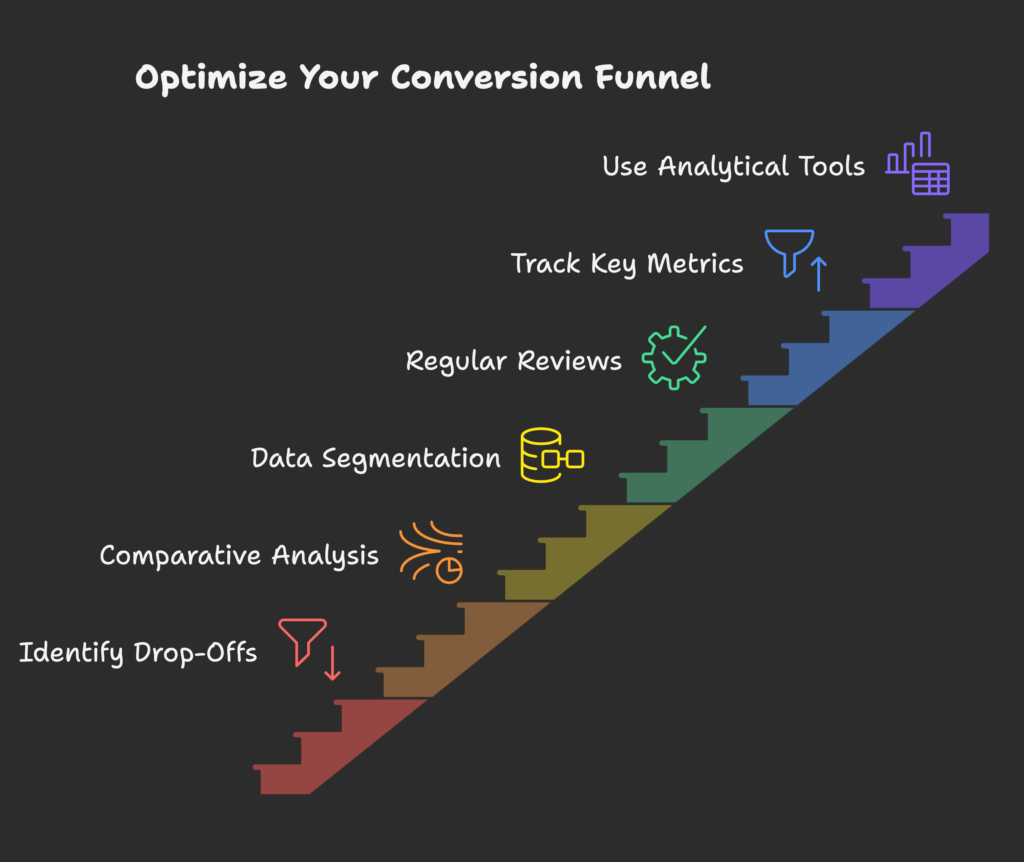
Regular analysis of your conversion funnel helps you spot problems and opportunities for improvement. Here’s how to approach it systematically:
Identify conversion drop-off points to find the weak links:
- Look for stages with unusually high abandonment rates
- Compare your metrics to industry benchmarks
- Note any recent changes that coincide with performance changes
- Check if drop-offs happen on specific devices or browsers
Comparative analysis of funnel stages reveals patterns:
- Compare conversion rates month-over-month to spot trends
- Look at how different traffic sources perform at each funnel stage
- Assess the impact of changes or updates on funnel performance
- Compare performance during promotions versus normal periods
Segmentation of funnel data provides deeper insights:
- Analyze new versus returning customer behavior
- Compare mobile users to desktop users
- Look at geographic differences in funnel performance
- Segment by product category or price point
Regular funnel review processes keep optimization ongoing:
- Schedule weekly checks of key metrics
- Conduct monthly deep-dive analyses
- Set up alerts for unusual changes in conversion rates
- Create a structured approach to testing improvements
Key Funnel Metrics to Track
While we’ve covered metrics for individual stages, these overarching measurements help you assess your funnel as a whole:
Overall conversion rate: The percentage of all visitors who make a purchase. The ecommerce average is around 2%, but top-performing stores can achieve 3-5% or higher.
Stage-by-stage conversion metrics: Track how visitors move from one stage to the next:
- Store visits to product page views (aim for 80%+)
- Product page views to add-to-carts (aim for 8-10%)
- Add-to-carts to checkout initiated (aim for 40-50%)
- Checkout initiated to purchase completed (aim for 70%+)
Lead-to-customer ratio: How many email subscribers or leads convert to paying customers. This helps measure the effectiveness of your nurturing campaigns.
Economic impact assessment: Calculate the financial benefits of funnel improvements:
- Revenue increase from higher conversion rates
- Profit margin improvements from higher average order values
- Customer acquisition cost reductions from better targeting
- Lifetime value increases from improved retention
Tools for Funnel Analysis
These tools help you collect and visualize data about your funnel performance:
Shopify Analytics provides built-in funnel visualization:
- Conversion over time reports show funnel performance trends
- Customer reports reveal buying patterns and behaviors
- Product analytics show which items drive conversions
- Acquisition reports reveal which marketing channels work best
Google Analytics integration offers deeper insights:
- Custom funnel reports to track specific user paths
- Advanced segmentation for detailed user behavior analysis
- Goal tracking to measure specific conversion objectives
- Attribution modeling to understand which touchpoints influence purchases
Heat mapping and session recording tools show exactly how visitors interact with your site:
- Hotjar, Lucky Orange, or Crazy Egg visualize where users click
- Session recordings reveal navigation patterns and confusion points
- Scroll maps show how far down pages users typically read
- Form analytics reveal where users abandon checkout forms
A/B testing platforms help you experiment with improvements:
- Google Optimize allows testing different page versions
- Shopify’s native A/B testing for product descriptions and images
- Email marketing platforms for testing different follow-up sequences
- Facebook’s A/B testing for ad creative and targeting
Now that you know how to analyze your funnel, you’re probably eager to start fixing any issues you find. Ready to learn practical optimization strategies for each stage? Let’s move on to making your funnel more effective!
Optimizing Your Shopify Conversion Funnel
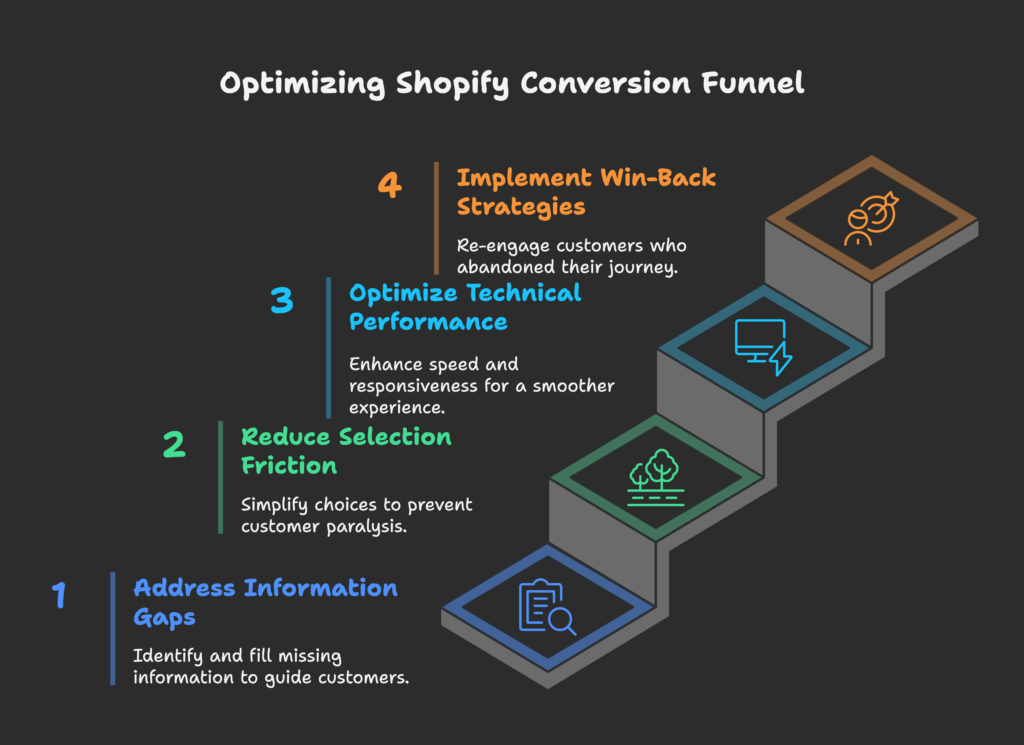
Addressing Information Gaps
Many customers abandon their journey because they can’t find the information they need. Here’s how to fill those gaps:
Content audit for missing information:
- Review customer service questions to identify common information needs
- Check product reviews for mentions of missing details
- Analyze search queries on your site to find what people are looking for
- Survey recent customers about what information they struggled to find
FAQ implementation strategies:
- Create product-specific FAQs addressing common questions
- Add general store FAQs about shipping, returns, and policies
- Use accordion-style FAQ sections to save space while providing details
- Update FAQs regularly based on new customer questions
Product information enhancement:
- Add complete sizing, dimensions, and specifications
- Include material details and care instructions
- Provide context for how products are used or worn
- Create comparison charts for similar products
Transparency improvements:
- Clearly show all costs including shipping before checkout
- Be upfront about delivery timeframes
- Explain your return policy in simple terms
- Disclose any relevant product limitations or considerations
Reducing Selection Friction
Too many choices or complex decision-making can paralyze customers. Here’s how to make selection easier:
Product filtering and categorization improvements:
- Add relevant filters based on how customers shop (size, color, price, etc.)
- Create logical category structures that match shopping habits
- Allow multiple filter selections simultaneously
- Ensure mobile filters are easy to use
Product comparison tools:
- Create side-by-side comparison features for similar products
- Highlight key differences between product options
- Allow customers to save comparisons for later
- Include customer ratings in comparison views
Guided selling approaches:
- Develop “Find your perfect [product]” quiz tools
- Create “Best for” tags (Best for beginners, Best value, etc.)
- Implement chat support to help with product selection
- Offer personalized recommendations based on previous interactions
Personalization strategies:
- Show recently viewed items for easy return
- Recommend products based on browsing history
- Personalize home and collection pages for returning visitors
- Create “Recommended for you” sections based on past purchases
Technical Performance Optimization
Slow or frustrating technical experiences can kill conversions. Focus on these improvements:
Site speed improvement strategies:
- Optimize and compress images
- Use a fast, responsive theme
- Minimize unnecessary apps that slow down your store
- Enable browser caching for returning visitors
Mobile responsiveness enhancement:
- Test your store on multiple devices and screen sizes
- Ensure buttons and links are large enough to tap easily
- Simplify navigation for smaller screens
- Optimize images and layouts for mobile viewing
User interface and experience improvements:
- Create clear visual hierarchies with important elements prominent
- Use consistent design patterns throughout your store
- Make sure error messages are helpful and clear
- Reduce the number of steps required to complete actions
Technical error elimination:
- Regularly test checkout process on different devices
- Fix broken links and 404 errors
- Ensure all forms work correctly and validate properly
- Test payment processing regularly to catch issues
Win-Back Strategies
Not all customers complete their journey the first time. These strategies help bring them back:
Abandoned cart email campaigns:
- Send the first reminder within 1-3 hours of abandonment
- Include images of abandoned products
- Consider offering a small discount or free shipping
- Create a series of 2-3 emails spaced over a few days
Retargeting ad implementation:
- Show ads featuring products viewed or left in cart
- Create different ad sequences based on funnel stage
- Set frequency caps to avoid overwhelming customers
- Include special offers for returning to complete purchase
SMS recovery strategies:
- Send brief, friendly reminders about cart items
- Include direct links back to checkout
- Time messages appropriately (not too late or early)
- Always include opt-out options
Incentive structures for return visits:
- Offer first-time buyer discounts
- Create limited-time offers for returning browsers
- Implement free shipping thresholds
- Use gamification like spin-to-win discounts
With these optimization strategies in your toolkit, you’re ready to transform your funnel into a sales-generating machine. But what does success look like in practice? Let’s look at some real-world examples of Shopify stores that have mastered the art of conversion funnels!
Case Studies and Examples
Successful Shopify Funnel Implementations
Learning from successful stores can inspire your own funnel optimization. Here’s how some top Shopify merchants have perfected their conversion journeys:
Dollar Shave Club revolutionized their industry with a simple funnel:
- Awareness: Used viral video marketing to explain their value proposition
- Interest: Created simple product pages focusing on benefits over features
- Desire: Emphasized convenience and cost savings compared to store-bought razors
- Action: Simplified signup process with just a few steps
- Loyalty: Built community through humorous email marketing and consistent experience
Result: Grew to over 4 million subscribers and sold to Unilever for $1 billion
Allbirds created a funnel focused on simplicity and sustainability:
- Awareness: Used targeted social media emphasizing comfort and eco-friendliness
- Interest: Designed clean, minimal product pages highlighting natural materials
- Desire: Incorporated authentic customer reviews and emphasized 30-day trial policy
- Action: Created a streamlined checkout with few steps
- Loyalty: Developed consistent post-purchase experience with sustainable packaging
Result: Achieved over $100 million in revenue within two years of launching
Beardbrand built a community-focused funnel:
- Awareness: Created educational YouTube content around beard care
- Interest: Developed detailed guides and product comparison tools
- Desire: Used storytelling and aspiration in product descriptions
- Action: Implemented quiz-based product recommendations
- Loyalty: Built an engaged community through consistent content
Result: Grew from blog to multi-million dollar business with strong repeat purchase rate
The key lessons from these successes include:
- Focusing on a clear, simple value proposition
- Using content marketing to build awareness and trust
- Creating frictionless shopping experiences
- Building community and relationships with customers
Industry-Specific Funnel Approaches
Different product categories require different funnel strategies. Here’s how to adapt your approach based on what you sell:
Fashion and apparel funnels should focus on:
- Visual storytelling with lifestyle photography
- Size guides and fit information to reduce returns
- Style-focused content marketing and lookbooks
- Social proof through user-generated content
Beauty and skincare funnels should emphasize:
- Educational content about ingredients and benefits
- Before/after results and testimonials
- Detailed product information for ingredient-conscious shoppers
- Samples and starter kits to reduce first-purchase risk
Home goods and furniture funnels need:
- Detailed dimensions and specifications
- Room context photography showing products in use
- Extended consideration phase content like buying guides
- Clear shipping and delivery information
Subscription vs. one-time purchase models require different approaches:
- Subscription funnels should emphasize long-term value and convenience
- One-time purchase funnels need stronger immediate desire triggers
- Subscription models should offer easy management and flexibility
- One-time purchases benefit from cross-selling and follow-up marketing
By adapting these industry-specific approaches to your particular niche, you can create a funnel that resonates with your exact target audience. Now, let’s put everything together with a practical implementation plan!
Implementation Guide
Step-by-Step Implementation Plan
Ready to transform your Shopify store’s conversion funnel? Follow this roadmap to success:
1. Audit your current funnel performance (Week 1)
- Set up proper tracking in Shopify Analytics and Google Analytics
- Establish baseline metrics for each funnel stage
- Identify the biggest drop-off points in your current funnel
- Survey recent customers about their shopping experience
2. Prioritize improvements based on impact (Week 2)
- Focus first on stages with the largest drop-offs
- Prioritize changes that affect the most visitors
- Balance quick wins against longer-term strategic improvements
- Create a spreadsheet ranking improvements by potential impact and effort
3. Optimize product pages (Weeks 3-4)
- Enhance product descriptions with benefit-focused content
- Improve product photography and consider adding videos
- Add social proof elements like reviews and testimonials
- Implement A/B testing to compare different approaches
4. Streamline checkout process (Weeks 5-6)
- Reduce form fields to the minimum necessary
- Add express payment options like Shop Pay or Apple Pay
- Improve mobile checkout experience
- Set up abandoned cart recovery emails
5. Enhance customer retention (Weeks 7-8)
- Implement post-purchase email sequences
- Set up a simple loyalty or rewards program
- Create personalized recommendations for repeat customers
- Improve unboxing experience with branded packaging
6. Measure results and iterate (Ongoing)
- Compare new metrics against your baseline
- Identify what worked and what didn’t
- Continue A/B testing different approaches
- Establish regular funnel review sessions (monthly recommended)
Tools and Resources
These tools can help you implement and optimize your conversion funnel:
Shopify apps for funnel optimization:
- Privy or Justuno for email capture and exit intent popups
- Loox or Junip for photo reviews and testimonials
- Klaviyo or Omnisend for email marketing automation
- Bold Upsell or ReConvert for upselling and cross-selling
Analytics tools:
- Google Analytics for detailed visitor tracking
- Hotjar or Lucky Orange for heat mapping and session recording
- Glew.io or Lifetimely for customer lifetime value analysis
- Shopify’s built-in analytics for basic funnel visibility
Testing platforms:
- Google Optimize for free A/B testing
- VWO or Optimizely for advanced testing capabilities
- UsabilityHub for quick user feedback
- Maze for prototype testing before implementation
Educational resources:
- Shopify’s own blog and help center
- Ecommerce podcasts like Shopify Masters
- Online courses on platforms like Udemy or Coursera
- Industry reports from research firms like Baymard Institute
With the right tools and a systematic approach, you can transform your conversion funnel step by step. But what’s coming next in the world of ecommerce funnels? Let’s peek into the future!
Future Trends in Conversion Funnel Optimization
Emerging Technologies
The future of conversion funnels is being shaped by these cutting-edge technologies:
AI and machine learning are revolutionizing personalization:
- AI-powered product recommendations that learn from browsing patterns
- Predictive analytics that anticipate customer needs
- Automated price optimization based on customer behavior
- Smart chatbots that can guide customers through product selection
Personalization advances are creating truly individual experiences:
- Dynamic product pages that change based on visitor preferences
- Personalized search results ordered by likely relevance
- Custom pricing and promotions based on customer loyalty
- Individualized email content beyond just adding a name
Omnichannel integration is blurring the lines between shopping venues:
- Seamless experiences across mobile, desktop, and in-store shopping
- Social commerce allowing purchases directly from Instagram or TikTok
- AR technologies letting customers “try before they buy”
- Voice commerce through smart speakers and assistants
Upcoming Shopify features to watch for:
- Enhanced native checkout customization options
- More powerful built-in analytics and reporting
- Expanded international selling capabilities
- Improved mobile shopping experiences
Staying ahead of these trends will give your store a competitive advantage as customer expectations continue to evolve. The stores that adapt fastest to these technologies will likely see the biggest gains in conversion rates.
Conclusion
Creating an effective Shopify conversion funnel isn’t a one-time project—it’s an ongoing process of measurement, optimization, and refinement. By understanding each stage of the customer journey from awareness through loyalty, you can systematically improve the shopping experience and boost your sales.
Remember these key principles as you optimize your funnel:
- Focus on the customer experience at every stage
- Use data to identify problems and measure improvements
- Test changes systematically rather than making assumptions
- Prioritize improvements based on potential impact
- Think long-term about customer lifetime value, not just immediate sales
When implemented correctly, a well-optimized conversion funnel can transform your business, leading to:
- Higher conversion rates and increased revenue
- Better customer experiences and satisfaction
- More efficient marketing spend with lower acquisition costs
- Stronger customer loyalty and higher lifetime value
- Competitive advantage in your market niche
Start by analyzing your current funnel, identifying the biggest drop-off points, and making targeted improvements. Track your results, learn from what works, and continue optimizing over time.
Looking for a quick way to supercharge your Shopify store’s conversion funnel? Remember that Growth Suite app can help automate many of the strategies we’ve discussed, making it easier than ever to increase your sales and grow your business.
References
- Shopify Enterprise Blog. (2024, February 12). How to Run a Conversion Funnel Analysis to Increase Sales. https://www.shopify.com/enterprise/blog/conversion-funnel-analysis
- First Pier. (2016, December 24). Building the Your Funnel for Shopify: A Step-by-Step Guide. https://www.firstpier.com/resources/conversion-funnel-shopify
- Shopney. Shopify Conversion Funnel: Build Your eCommerce Cashflow. https://shopney.co/blog/how-to-build-ecommerce-conversion-funnel/
- Shopify Blog. (2024, January 2). 20 Key Ecommerce Metrics To Track In 2024. https://www.shopify.com/blog/basic-ecommerce-metrics
- Shopify Blog. (2024, November 21). What Is a Sales Funnel? How To Build One in 2025. https://www.shopify.com/blog/sales-funnel
- ConvertCart. (2024, January 8). 5 Stages of an eCommerce Conversion Funnel (+Examples). https://www.convertcart.com/blog/ecommerce-conversion-funnel
- Shopify Enterprise Blog. (2024, February 12). How to Run a Conversion Funnel Analysis to Increase Sales. https://www.shopify.com/no/enterprise/blog/conversion-funnel-analysis
- Manifest AI Blog. How To Create A Successful Shopify Sales Funnel? https://blog.getmanifest.ai/shopify-sales-funnel/